China builds bridges on uneven ground in Central Asia with new collective treaty

China’s June 2025 treaty with the five Central Asian states aims to institutionalise the Belt and Road Initiative, promoting connectivity, trade and digital cooperation while establishing a long-term legal foundation for a reshaped regional order. The agreement strengthens China’s influence and enhances Central Asia’s integration. But it also renews concerns over debt dependence, the environmental impacts of the Belt and Road Initiative and the concentration of strategic power.
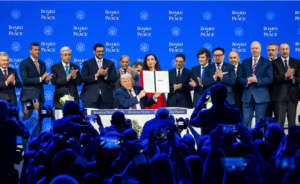
On 18 June 2025, China signed a Treaty of Permanent Good-Neighborliness and Friendly Cooperation with all five Central Asian republics. The treaty demonstrates China’s evolving statecraft — fusing infrastructure, diplomacy and legal frameworks into a single vision of regional order. It is potentially Beijing’s most ambitious attempt yet to reshape the norms of international cooperation.
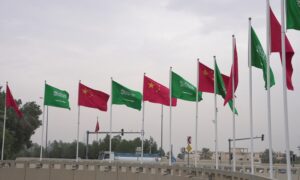
The treaty institutionalises China’s Belt and Road Initiative (BRI) through legally binding multilateralism. The joint statement issued during the second China–Central Asia Summit in 2025 highlighted the BRI as a central pillar of cooperation. It outlined commitments on trade facilitation, connectivity and digital Silk Road projects. These outcomes reinforce the treaty’s function as a long-term legal framework for the BRI with enforceable commitments. The treaty is a regulatory anchor for Beijing’s investments and a geopolitical firewall against external interference.
While most international treaties of this nature are bilateral, this agreement is multilateral and eschews hierarchies — similar to ASEAN’s Treaty of Amity and Cooperation, which China joined in 2003. The treaty’s non-aligned yet cooperative architecture breaks with the zero-sum logic of military alliances like NATO or the Soviet-era Collective Security Treaty Organization, establishing a demilitarised framework of strategic trust focused on stability through rules rather than armaments.
One international concern surrounds Article 3 of the treaty, prohibiting participation in alliances or groupings directed against other parties. Similar clauses already exist in China’s bilateral treaties with all five Central Asian states. Yet these provisions’ multilateral codification potentially invites perceptions of strategic exclusivity.
Central Asia is riddled with unresolved disputes — ethnic enclaves, water rights, border disputes and resource friction. The alignment of such diverse actors reflects China’s growing convening power as well as the increasing agency of Central Asian states in their coordinated development. Developments such as the normalisation of Tajikistan–Uzbekistan relations, border dispute resolutions and transboundary water-sharing agreements signal momentum towards integration — onto which China has grafted its BRI ambitions.
The treaty’s deeper strategic purpose is that it offers the BRI legal insulation and long-term predictability. The BRI has already transformed the region from a post-Soviet periphery into a logistical artery linking China to Europe. China–Central Asian trade skyrocketed in value from US$460 million in 1992 to US$94.8 billion by 2024, making China the region’s largest trading partner since 2021. Direct investment stock surpassed US$17 billion in 2024.
China–Europe rail freight trips through Central Asia surged from roughly 1700 in 2016 to over 19,000 in 2024. Enhanced connectivity under the BRI has enabled Central Asia’s landlocked nations to reduce their reliance on volatile Russian trade routes. Russia has largely accepted China’s growing economic footprint in the region in return for Chinese support during the conflict in Ukraine, both technologically and economically.
The China–Kyrgyzstan–Uzbekistan railway — bypassing Russian territory — broke ground in December 2024 as part of the Trans-Caspian International Transport Route linking China to Europe. This corridor could shorten freight travel time from Shanghai to Europe to around 10 days — significantly faster than the 20-day land or 45–60-day maritime routes. The treaty formalises non-interference clauses, security cooperation and dispute resolution norms, reducing risks of political instability, foreign meddling or resource conflicts derailing BRI corridors.
The treaty signatories’ commitments to refraining from joining alliances ‘targeting other treaty members’ effectively bar NATO and similar Western-aligned organisations from embedding within Central Asia, while respecting the principle of non-alignment. Russia’s silent assent to the treaty underscores Moscow’s increasing dependence on and convergence with China.
At the same time, Central Asia’s debt exposure to China is rising. Countries like Tajikistan and Kyrgyzstan are deeply reliant on Chinese loans that are often collateralised by mineral rights or critical infrastructure. In Kyrgyzstan, corruption scandals tied to Chinese-funded projects have precipitated political upheaval. Hydropower-induced deforestation and mining-related displacement are similarly controversial among local populations.
The underlying power asymmetries and occasional divergences of interests are hard to ignore. China’s mounting regulatory authority over regional infrastructure and trade routes may narrow the strategic policy space of Central Asian governments. This raises questions about whether the treaty reflects consensual multilateralism rather than a calculated projection of Chinese influence.
China seeks to propose a ‘non-aligned but not neutral’ rules-based development order rooted in sovereignty, infrastructural interdependence, political non-interference and cooperative security. It could be a model for other regions with a growing Chinese presence.
But in other regions, the emphasis on non-interference and elite-led development may clash with calls for participatory governance or environmental accountability. The durability of a rules-based order built around a single dominant actor, exemplified by the current US administration, is now under the doubt — especially when legal commitments are not backed by robust enforcement or inclusive oversight.
Questions remain as to whether China will be willing — and able — to mediate Central Asian disputes without appearing hegemonic and whether the treaty’s legal architecture can constrain power or merely consolidate it. Central Asian governments should institutionalise equitable policy to ensure that BRI-linked growth translates into fairly distributed outcomes across social sectors.
It marks a milestone in Beijing’s Eurasian strategy and a potential harbinger of the strategies China will prioritise to shape a multipolar world — largely through railroads, legal instruments and reimagined regionalism. The treaty signals a future where the Belt and Road is not only a map, but a manual for institution building.
Hao Nan is Nuclear Futures Fellow (2025–2026) with the Ploughshares Fund & Horizon 2045. He previously served at East Asian intergovernmental organisations such as the Trilateral Cooperation Secretariat in Seoul, South Korea, and the ASEAN–China Centre in Beijing, China.