Belt and Road Initiative: Driving global connectivity, stability, and sustainable inclusive growth

Since its inception, the Belt and Road Initiative (BRI) has developed into one of the most influential platforms for promoting global connectivity and cooperative development. At a time when unilateralism is resurging and technological competition is intensifying, the initiative – conceived as a new type of global public good provided by China – serves multiple functions. It not only continues to advance the construction of an open world economy, but also creates more valuable and sustainable development opportunities, particularly for the vast number of developing countries. The significance of the BRI spans across economic logic, political economy dynamics, and international development governance, while also demonstrating unique value in addressing the global challenges that accompany technological transformation.
BRI resonates with shared development aspirations of countries across the world
Over the past several decades, the global economy has grown at an unprecedented pace, with efficiency-oriented international cooperation providing development opportunities for a wide range of countries. In 2024, China’s total imports and exports to countries participating in the BRI reached 22.07 trillion yuan ($3 trillion), and its non-financial direct investment reached 239.93 billion yuan. From a purely economic standpoint, the BRI and its underlying principle of openness have become essential tools for promoting development. By facilitating the efficient flow and optimal allocation of goods, services, information, capital, technology, and human talent among participating countries, the initiative enables states to capitalize on their comparative advantages, seize opportunities presented by scientific and technological revolutions, and accelerate industrial upgrading alongside innovation-driven growth. In this sense, the BRI conforms to the fundamental laws of global economic activity and international trade, resonates with the shared development aspirations of all countries, and injects strong impetus into the transition toward a more sustainable and inclusive growth trajectory.
Deepening economic cooperation under BRI counters unilateralism and hegemonism
At the same time, the international environment has been undergoing profound changes, with political economy factors increasingly becoming the decisive variables that shape patterns of global development. Against this backdrop, the BRI, along with the principle of openness and cooperation that it embodies, has assumed a more prominent role as a stabilizing force and a safeguard of international order. Currently, tensions between unilateralist tendencies and multilateral cooperation continue to deepen. While certain countries are inclined toward inward-looking policies and reinforce zero-sum approaches to international relations, the vast majority of developing nations demand fairer opportunities and a more predictable environment for growth. Data from the World Trade Organization shows that, as of mid-October 2024, the stockpile of import restrictions in force was affecting an estimated $2.9 trillion representing 11.8 percent of world imports. By strengthening infrastructure connectivity, deepening trade and investment linkages, and improving institutional frameworks for cooperation, the BRI helps to counter unilateralism and hegemonism. In doing so, it promotes the emergence of a more inclusive, balanced, and open global economic system, thereby injecting both certainty and stability into global governance at a time when such qualities are in short supply.
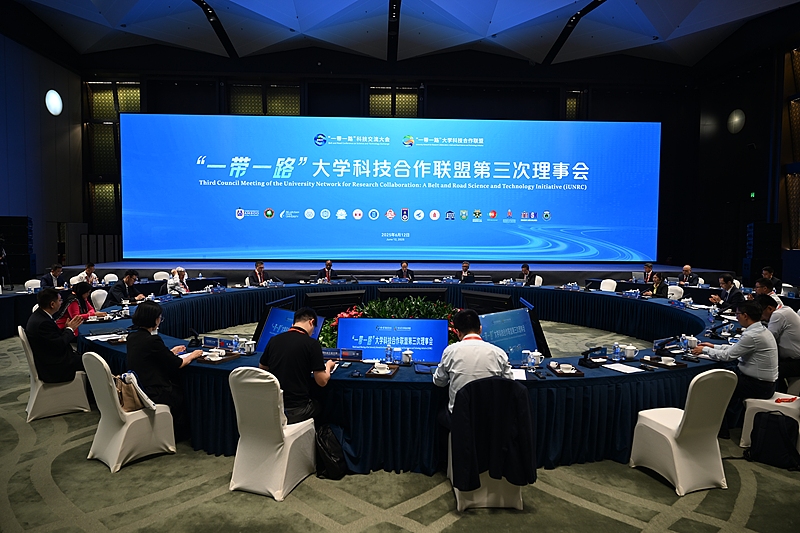
Participants prepare for the Third Council Meeting of the University Network for Research Collaboration: A Belt and Road Science and Technology Initiative in Chengdu, Sichuan Province, China, June 12, 2025. /CFP
Enabling developing countries to integrate into global innovation and digital ecosystems
Looking ahead, technological change will become even more closely intertwined with economic development and political transformation, further magnifying both opportunities and risks. While technological progress enhances overall global productivity, its benefits are distributed unevenly: developed countries typically retain dominance in innovation and high-value-added sectors, while many developing countries face the risk of marginalization. About one-third of the world’s population has no access to the internet, and most of them are concentrated in developing countries. As a result, global development disparities risk becoming entrenched and even widening.
In this context, the BRI’s cooperative framework offers meaningful solutions. Through strengthening infrastructure networks, promoting technology transfer, supporting digital connectivity, and enhancing capacity-building, the initiative helps developing countries integrate more effectively into global innovation and digital ecosystems. This not only reinforces their endogenous development capacity, but also mitigates the structural imbalances triggered by technological revolutions. By facilitating broader technology diffusion and fostering inclusive development, the BRI helps ensure that developing countries can share in the dividends of the new technological wave, thereby slowing or reversing the trend of an expanding North–South divide.
China: From “world factory” to major contributor to global economic growth and sustainability
For decades, China has consistently played the role of a “stabilizer” of the global economy. In earlier phases of globalization, China’s position as the “world’s factory,” underpinned by its abundant, skilled, and cost-competitive labor force, provided a solid foundation for global growth. Today, with the BRI as a cornerstone of its international engagement, China is offering a new range of global public goods to the international community. These include tangible contributions such as cross-border infrastructure and development financing, as well as intangible mechanisms such as frameworks for technological cooperation and innovations in multilateral governance. Collectively, these contributions not only mobilize and integrate the resource potential and development opportunities of participating countries, but also foster the creation of a more stable, equitable, and sustainable international order. In this way, the BRI reinforces China’s role not only as an economic stabilizer but also as a responsible major power actively contributing to the improvement of global governanceand world development.