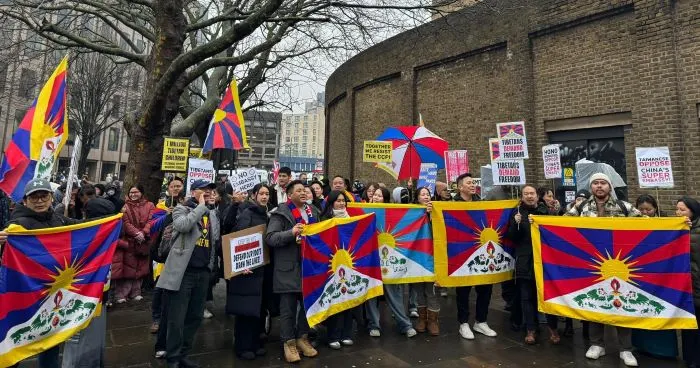
Free Tibet, a London-based Tibet rights group and allied rights organisations which have been at the forefront of sustained protests, public rallies, and advocacy efforts against China’s proposed mega embassy at Royal Mint Court, near the Tower of London have one again intensified their opposition, warning that the project poses serious national security risks and threatens vulnerable exile communities. The UK government is expected to announce its decision on January 20.
According to Free Tibet, if approved, the planned embassy would become the largest Chinese embassy in Europe, spanning approximately 20,000 square metres, nearly ten times the size of a typical embassy. Campaigners argue that the sheer scale of the facility and its strategic location raise alarm bells far beyond routine diplomatic considerations.
In an open letter addressed to UK Housing Secretary Steve Reed, UK-based Tibetans and Tibet support groups, representing tens of thousands of supporters, urged the government to reject the proposal, citing both national security and human rights concerns. The letter noted that the embassy’s proximity to critical communications infrastructure, including undersea cables, poses a significant security risk. It further references warnings from the UK’s domestic intelligence agency MI5, which has reportedly advised that the mega-embassy could “significantly endanger UK national security.”
The concerns come amid recent revelations about Chinese intelligence operations in Britain, including attempts by agents linked to Beijing to recruit individuals connected to Westminster by offering substantial financial incentives in exchange for sensitive information.
Tibetan groups argue that the proposed embassy must also be assessed against China’s documented record of transnational repression, including intimidation, surveillance, and violence carried out beyond its borders.
The letter highlighted several incidents that have heightened fears among exile communities, including the 2022 assault on a Hong Kong protester, who was dragged into the Chinese consulate in Manchester and beaten by Chinese officials, an incident captured on video. It also referenced reports of bounties issued by Beijing on UK-based Hongkongers, and testimonies from Tibetans, Uyghurs, and Chinese dissidents who say they face persistent harassment and monitoring in the UK.
“By allowing China a superbase in London, the UK government will be putting citizens, residents, and vulnerable communities at further risk,” the letter warns, calling such a decision a “reckless abandonment” of the government’s duty to protect those living in Britain.
China first purchased the Royal Mint Court site in 2018, with plans to consolidate its diplomatic operations in London. In December 2022, Tower Hamlets Council rejected the proposal, citing safety, security, and protest-related concerns. Beijing resubmitted an identical application in August 2024, after which the UK government assumed authority over the decision.
Since then, Free Tibet, along with Uyghur, Hong Kong, and Chinese democracy groups, has organised repeated protests outside the site, drawing attention to what they describe as the embassy’s role as a potential strategic outpost, rather than a conventional diplomatic facility.
Large demonstrations are expected to continue in the lead-up to the January 20 decision, with activists urging Members of Parliament to raise the issue in Parliament and the public to support ongoing campaigns calling for rejection of the proposal.
“This is a moment for the UK government to act with leadership,” Free Tibet said in its announcement, urging ministers to deliver an “unequivocal and absolute rejection” of the proposed embassy.
“Anything less,” the group warned, “would be an insult to the British people and a failure of national leadership.”