S.China’s Beihai broadens its footprint in BRI economic networks

At the Tieshan Port Public Wharf in Beihai, a key transportation hub in South China’s Guangxi Zhuang Autonomous Region, the scene resembles a vast shelf displaying goods from around the world.
Within sight, a stack of golden yellow logs from Vietnam towers nearby, and just a few hundreds meters away, nickel from the Philippines and black coal from Indonesia are being unloaded. On the other side of the wharf, soybeans from Latin American countries are being transferred onto trucks – a vivid testament to Tieshan Port’s role as a crucial gateway linking China with Belt and Road countries and beyond.
On site at the busy port, Pan Junlin, deputy manager of the information department at Beibu Gulf Port Beihai Terminal Co, told the Global Times that the Tieshan Port, as a key node connecting land and sea, handles critical import and export tasks. Many goods come from Belt and Road partner countries, and after processing, are shipped back to the regional markets.
Tieshan Port Public Wharf, part of the greater Beibu Gulf Port that includes several ports in the coastal cities of Beihai, Qinzhou, and Fangchenggang in Guangxi, is just a prime example of the region’s growing role as a trade hub.
Located on the southern coast of the Beibu Gulf, Beihai borders the Guangdong-Hong Kong-Macao Greater Bay Area to the east, is backed by Southwest China, and faces Southeast Asia. As one of the earliest departure points of the ancient Maritime Silk Road, Beihai is among China’s first coastal cities to open to the world.
Today, it is forging ahead, integrating into the China-proposed Belt and Road Initiative (BRI) and the New International Land-Sea Trade Corridor which is a key logistics network connecting China’s western regions to global markets.
From points to scope
Standing at the Tieshan Port Public Wharf, one can immediately sense the convenience of its trade links with Belt and Road countries, especially the ASEAN members. The port continues to drive regional cooperation and coordinated development.
Pan said that last year, Tieshan Port handled over 9 million tons of cargo from Belt and Road countries, out of a total throughput of around 42 million tons – about one-quarter of the total. Imports include nickel from the Philippines and coal from Malaysia and Indonesia, while exports cover finished paper, glass, and photovoltaic products. Some domestically produced goods are usually shipped to nearby Qinzhou Port and then transported via the New International Land-Sea Trade Corridor to inland regions such as Southwest China’s Chongqing Municipality, forming a seamless integrated logistics network.
The wharf’s regional connectivity advantages have also accelerated local industrial chains. Not far from the berths, a 200,000-square-meter grain and oil processing plant operates efficiently. Raw materials shipped from North and South Americas are processed through pre-treatment, extraction, and refining into edible oil and soybean meal for feedstuffs. These products supply the domestic market and are exported to parts of Southeast Asia, including Vietnam. Thanks to the convenient maritime routes, goods can reach Vietnam in about 12 hours.
The company’s current export volume remains small – less than 10 percent – however, beginning next year, the export structure will gradually shift, Zhang Yangyang, deputy general manager of Guangxi Bohi Agricultural Development Co, told the Global Times, noting that with the launch of the second-phase soybean production project next year and rising demand from neighboring countries, production capacity is expected to double.
“The company also plans to further expand exports, including to Belt and Road countries, providing high-quality products to related markets,” Zhang said.
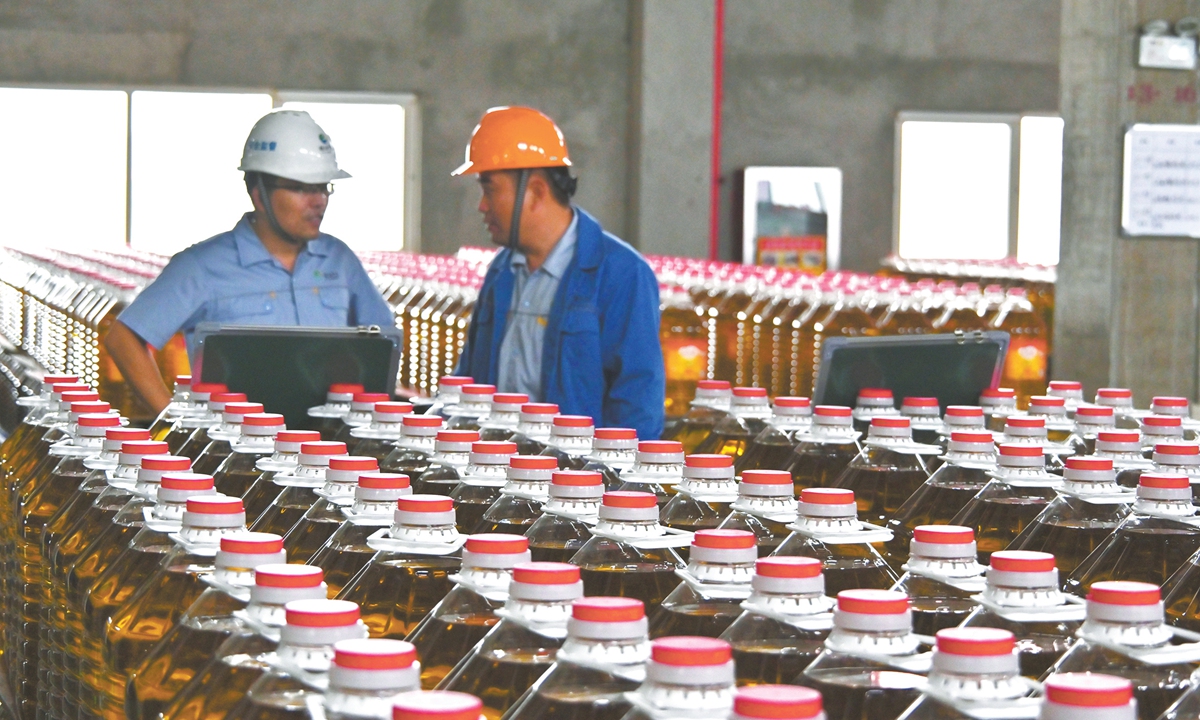
Workers inspect eligible oil packages at a soybean factory in Beihai, South China’s Guangxi Zhuang Autonomous Region. Photo: Tao Mingyang/GT
Another factory in the region sees a similar trend, leveraging the port’s connectivity to tap into trade opportunities with Belt and Road partner countries.
Nickel imported from the Philippines arrives at Tieshan Port Public Wharf and is then transported by truck to a factory just a few kilometers away. Through the factory’s hot-rolling production line, the slabs undergo heating, rolling, and coiling processes, ultimately producing hot-rolled steel coils with a thickness of just 1.8 millimeters before shipping to other countries and regions.
“Our hot-rolling process is fully automated, relying on precise pressure and temperature control, as well as an AI-powered surface-quality inspection system, enabling efficient production and supplying high-quality stainless steel products to both domestic and international markets,” Lu Chenyang, head of raw materials supply department of Guangxi BG New Materials Co, told the Global Times.
Beihai serves as a major channel for southwest and south-central regions to “go global” and an important Belt and Road hub, according to Lu. Lu said that his company chose Beihai for its superior location when the factory was first built.
Leveraging the port’s logistical advantages, the company can conveniently source mineral resources from ASEAN countries such as the Philippines.
Compared with traditional river-sea transport routes, exporting goods via Beibu Gulf Port significantly shortens shipping time, Lu said.
In addition, against the backdrop of deepening regional cooperation under the Regional Comprehensive Economic Partnership (RCEP) framework, economic and trade exchanges with partner countries have become smoother, providing greater certainty and convenience for the steel company’s import and export operations, the industry insider said.
Expanding networks
Beihai’s role in Belt and Road links continues to expand. In 2024, 25 African ports, including Durban, Cape Town, Saldanha Bay, Djibouti, Walvis Bay, and Port Said, maintained strong maritime trade links with the Beibu Gulf Port, transporting a total around of 6.73 million tons of commodities such as iron ore, coal, crude oil, and steel, CCTV news reported.
Beihai is seizing the major opportunities brought by the China-ASEAN Free Trade Area Version 3.0 and the implementation of RCEP, deepening its opening-up and cooperation with ASEAN and other Belt and Road partners.
Meanwhile, Beibu Gulf Port continues to expand its level of openness. The port now has 91 productive berths, including 84 that have opened to foreign vessels, with a total cargo handling capacity exceeding 450 million tons and container handling capacity exceeding 11.04 million TEUs. In 2025, an additional 11 berths will open to foreign use, marking a historic high.
With its maritime heritage, Beihai has long possessed an inherent openness, aligning with the country’s ongoing efforts toward further opening-up, Song Wei, a professor at the School of International Relations and Diplomacy at Beijing Foreign Studies University, told the Global Times, noting that the BRI has positioned Beihai as a key hub for China-ASEAN economic and trade cooperation, as well as an international logistics center linking land and sea.
“In the context of globalization, this role is particularly vital, facilitating smooth logistics flows and embedding the city into the global value chain,” she said.